
Laundry rooms, rec rooms and storage
Basement Floor Epoxy in Springfield, IL
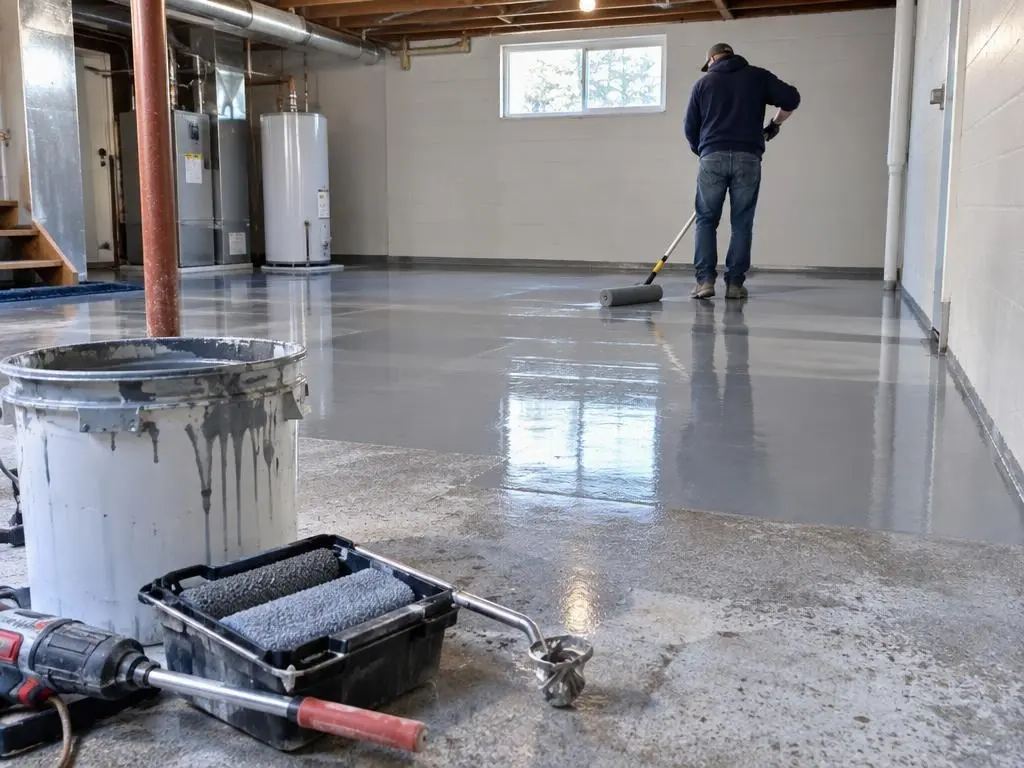
A clean, sealed basement floor, installed after we know how much moisture the slab is carrying.
- Free on-site estimates with a slab moisture check
- Diamond-ground prep and crack repair on every floor
- An itemized, written price before work begins
Basement Floors and Central Illinois Moisture
Basement floor epoxy turns a dusty, stained concrete floor into one that is easy to clean and pleasant to use. In Springfield, IL, it is also the floor job that most depends on testing. A basement slab sits against cool ground, and the city's average relative humidity is around 71%. Warm, damp summer air meets a cool slab and the floor can sweat. Moisture can also rise through the concrete from the soil. Either one can blister or lift a coating, so we measure before we recommend anything.
How we check a basement slab
- Moisture readings at several spots, including near walls and floor drains
- A look for efflorescence, the white mineral crust left when water moves through concrete
- Old paint, sealer, adhesive from past flooring, or tile that has to come off
- Cracks, especially any that are wide, uneven or wet
- Signs of past water: stains on the walls, rust on appliance feet, a working sump pump
Older Springfield basements
About 17.7% of Springfield homes were built in 1939 or earlier and another 16.5% in the 1940s and 1950s, based on 2019 to 2023 American Community Survey figures summarized by Point2Homes. Basements in those houses were often poured thin, patched over the years and painted more than once. Many have floor drains and low spots. We grind off old paint, fill and level where we can, and tell you if a slab is too damp or too broken for a coating to last.
When moisture is present
Some moisture is manageable. We can use a moisture-tolerant epoxy primer designed to go under the coating system on damp slabs. If water is actively coming in, through a wall crack, a failed drain or poor grading outside, that needs fixing first. Putting a coating over a wet slab only hides the problem until the coating fails.
Radon and basement work
An Illinois Times report citing the Illinois Department of Nuclear Safety found 29% of Sangamon County homes above the EPA action level of 4 pCi/L. Sealing a floor is not radon mitigation, and we do not sell it that way. If you are finishing a basement, test for radon first and have any mitigation system installed before the floor goes down, so we can coat around the pipe and seal the floor penetrations neatly.
Finish options for basements
A solid color epoxy is the simplest and suits laundry rooms and storage. A partial flake broadcast adds some pattern and hides dust. For finished rec rooms and home gyms, a full flake or a smooth satin topcoat gives a cleaner look. Basements see no sunlight, so the UV advantage of polyaspartic matters less here, and epoxy's thicker build helps on uneven older slabs.
Mine subsidence and cracks
Sangamon County is a mandatory county for mine subsidence insurance, and the Illinois Mine Subsidence Insurance Fund places 52,838 of its 92,815 housing units in mine-related zones. Illinois Emergency Management Agency guidance lists cracks in basement floors and walls, especially ones that appear suddenly and widen, as possible signs of subsidence. Most basement cracks are ordinary shrinkage. When one is not, we will tell you before any coating goes down.
What This Covers
Basement floor epoxy covers the slab from wall to wall, worked around drains, posts and utilities.
Moisture testing
Readings across the slab before we choose a primer or system.
Paint, tile and adhesive removal
Old coatings and flooring residue ground off to bare concrete.
Crack and low-spot repair
Cracks filled and shallow low spots leveled where practical.
Moisture-tolerant primer
A primer designed for slabs with some vapor drive, where readings allow.
Solid, flake or satin finishes
A finish matched to how the room is used.
Typical Basement Floor Epoxy Costs
| Item | Published range |
|---|---|
| Installed epoxy, per square foot | $4 to $10 |
| Basement floor, 300 to 2,000 sq ft | $1,200 to $20,000 |
| Basement epoxy or self-leveling overlay | $3 to $7 per sq ft |
| Moisture and hardness testing | $50 to $300 |
| Crack and chip patching | $25 to $250 |
National ranges from HomeGuide (epoxy, resurfacing and polyaspartic guides) and HomeAdvisor (patching). Springfield prices can differ with moisture, old coatings and how much of the floor is coated. Your written estimate is the price.
How It Works
1. Test and inspect
Moisture readings, a crack check and a look for signs of past water.
2. Prep
Grind off paint and residue, vacuum, fill cracks and level low spots.
3. Prime and coat
Primer chosen for the readings, then color or flake and a topcoat.
4. Cure
Foot traffic after the cure time we give you, then furniture and storage back in.
Basement Floor Epoxy Questions
Can you epoxy a damp basement floor?
A slab with some vapor drive can often take a moisture-tolerant primer. A floor with water actively coming in needs that fixed first. We test before we recommend anything.
How much does basement floor epoxy cost?
HomeGuide lists basement floors of 300 to 2,000 square feet at $1,200 to $20,000, or $4 to $10 per square foot for epoxy. Paint removal and crack repair add to it. We give a written price after testing.
Does epoxy stop radon?
No. A coating can seal cracks, but it is not a mitigation system. Test for radon and install mitigation first if you need it.
Can epoxy go over painted basement concrete?
The paint has to come off. Coatings bond to the concrete, and paint over a basement slab often has poor adhesion already. We grind it away before coating.
Basement Floor Epoxy Service Areas
- Epoxy Flooring in Springfield, IL
- Epoxy Flooring in Chatham, IL
- Epoxy Flooring in Rochester, IL
- Epoxy Flooring in Sherman, IL
- Epoxy Flooring in Riverton, IL
- Epoxy Flooring in Leland Grove, IL
- Epoxy Flooring in Jerome, IL
- Epoxy Flooring in Grandview, IL
- Epoxy Flooring in Southern View, IL
- Epoxy Flooring in Spaulding, IL
- Epoxy Flooring in Auburn, IL
- Epoxy Flooring in Pawnee, IL
- Epoxy Flooring in Williamsville, IL
- Epoxy Flooring in Athens, IL
- Epoxy Flooring in Petersburg, IL
- Epoxy Flooring in New Berlin, IL
- Epoxy Flooring in Pleasant Plains, IL
- Epoxy Flooring in Loami, IL
- Epoxy Flooring in Divernon, IL
- Epoxy Flooring in Virden, IL
- Epoxy Flooring in Taylorville, IL
- Epoxy Flooring in Lincoln, IL
- Epoxy Flooring in Jacksonville, IL
Get a Basement Floor Epoxy Estimate
Free moisture checks and estimates for basement floors in Springfield, IL.